Europe in December is a particular kind of special. Wooden chalets glowing under festive lights, the smell of roasting chestnuts and mulled wine, a giant Christmas tree in the middle of a medieval square. The best European Christmas markets run from late November to Christmas Eve, and most are free to wander, so the only hard part is choosing where to go.
If it’s tradition you’re after, Germany is the heartland, with Dresden’s Striezelmarkt dating all the way back to 1434 and Nuremberg doing the textbook version. Strasbourg and Vienna are the ones for sheer scale and atmosphere, while Prague, Budapest and Kraków stretch your money furthest and stay quieter.
For something out of a storybook, the smaller towns like Colmar, Bruges and Rothenburg are hard to beat. And if a trip across the Channel isn’t on the cards, Winchester and London’s Southbank prove you don’t have to go far. Below are 18 of the best Christmas markets in Europe, plus the practical bits you actually need.
What makes a European Christmas market worth the trip?
The tradition started in the German-speaking world in the late Middle Ages. Dresden’s Striezelmarkt was first recorded in 1434, when it ran for a single day so locals could buy meat before Christmas. Earlier “December markets” existed in Vienna as far back as 1298, but those were provisioning fairs rather than the festive markets we know now.
What you get today is fairly consistent across countries. Rows of wooden chalets, mulled wine in a mug, roasted chestnuts, food stalls and market stalls of handcrafted ornaments, and a giant Christmas tree somewhere in the middle of it all. What changes is the setting and the regional food, and that’s really what separates a market you’ll remember from one that blurs into all the others. The best of them frame their stalls against historic buildings, a cathedral or a floodlit city hall, and that backdrop does half the work.
The best Christmas markets in Europe
1. Strasbourg, France – the Capital of Christmas
Strasbourg has called itself the Capitale de Noël for centuries, and the numbers back up the boast. The Christkindelsmärik dates back to 1570, making it the oldest Christmas market in France, and the festivities now spread across roughly 11 squares throughout the UNESCO World Heritage old town.
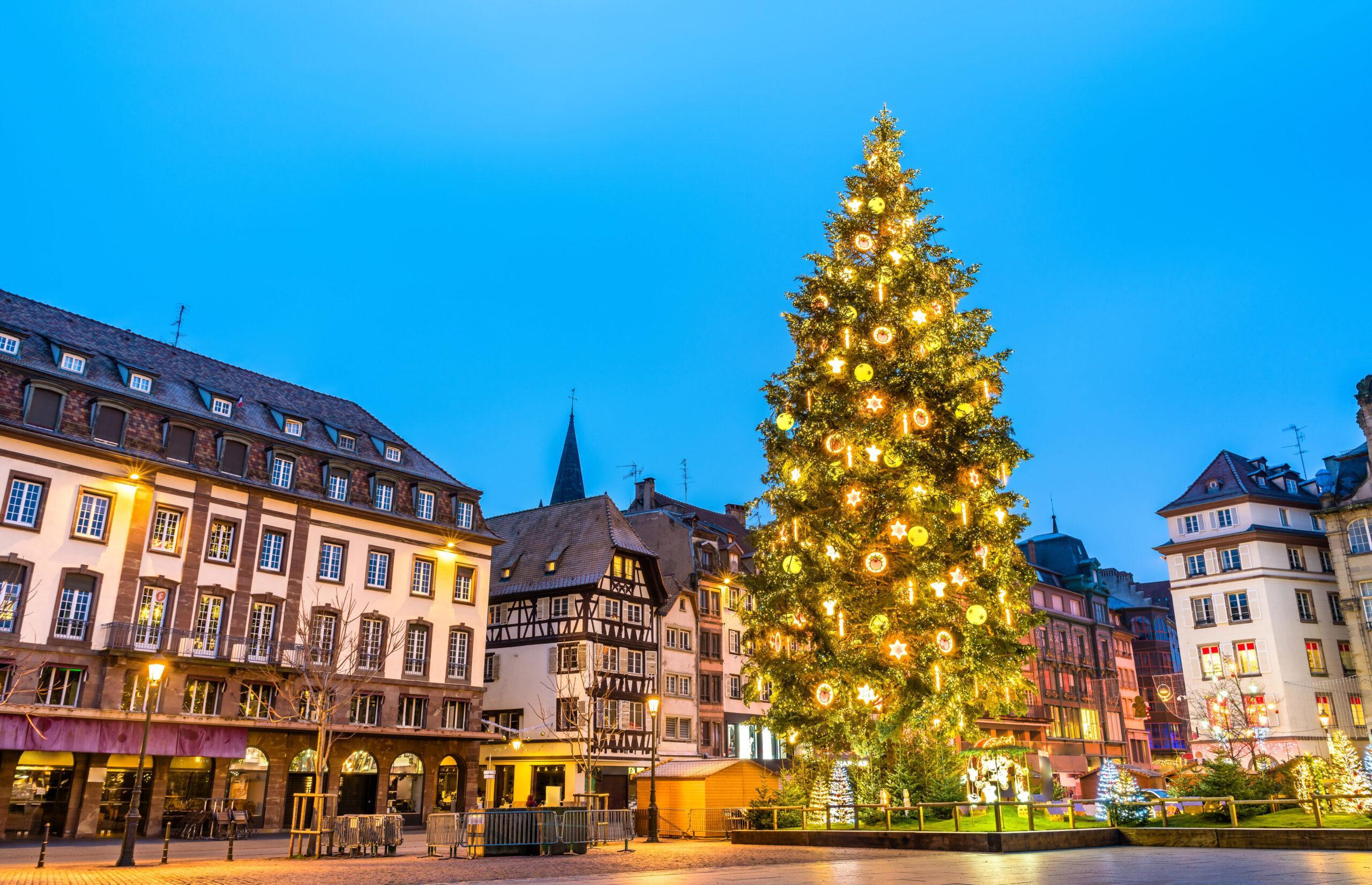
The centrepiece is the Grand Sapin in Place Kléber, a giant Christmas tree that stands around 30 metres tall, one of the largest in Europe, lit with several kilometres of lights. Every evening on the hour between 4pm and 9pm, it’s set to a music and light show. The original market sits at Place Broglie, while the wooden chalets clustered beneath the cathedral’s carved sandstone facade make for the most photographed corner of the city.
Dates for 2026: 27 November to 27 December. Cost: free entry. Don’t miss: Alsatian food, which is a cut above the usual sausage-and-pretzel fare. Look for tarte flambée (flammekueche), bredele biscuits and a hot Gewürztraminer.
One caveat: weekends after dark get packed, and the narrow streets between squares can feel crammed by late afternoon. Go on a weekday in late November or early December for the calmer version.
2. Vienna, Austria – imperial grandeur
Vienna does Christmas markets with a palace-courtyard sort of elegance. The most famous is the one on Rathausplatz, where the neo-Gothic city hall provides the backdrop and a giant Christmas tree towers over the square, and it’s one of the largest in Europe, with around 150 market stalls and an ice rink that loops through the square. There are several more dotted around the city, including the market at Schönbrunn Palace and the Art Advent on Karlsplatz, so you can easily fill a few days in the city centre.
Dates for 2026: the various markets run roughly 15 November to 26 December (the Rathausplatz market typically runs the longest). Cost: free entry; ice skating is separate. Good for: families, thanks to the rink and the workshops aimed at younger children.

3. Salzburg, Austria – Alpine Advent on Cathedral Square
Salzburg trades on a different kind of charm from Vienna: smaller, set against the Alps, and famous for being the city of Mozart and The Sound of Music. The main Christkindlmarkt gathers on Cathedral Square and Residenzplatz, with traditional wooden huts strung beneath lighting that hangs overhead like rows of stars. It opens each year on the Thursday before the first Sunday of Advent and runs right through to 1 January, so it’s one of the few that carries on past Christmas.
Dates for 2026: from late November to 1 January (the market opens the Thursday before Advent). Cost: free entry. Good for: pairing with Vienna and Munich on a rail loop, and for staying festive into the new year.
4. Nuremberg, Germany – the classic Christkindlesmarkt
If you want the textbook German Christmas market, this is it. Nuremberg’s Christkindlesmarkt, on the Hauptmarkt in the city’s old town, dates back to 1628 and draws around two million visitors a year. Every stall has the same red-and-white striped roof, and there’s a quality rule that means the traditional crafts and food stalls sell goods that are handcrafted rather than mass-produced tat.
The opening ceremony is the signature moment, when the Christkind, a child dressed in gold representing the spirit of Christmas, delivers a prologue from the church balcony. Pick up Nuremberg Lebkuchen (spiced gingerbread) and the little Zwetschgenmännle figures made from prunes.
Dates for 2026: 27 November to 24 December. Cost: free entry. A word of warning: it’s very popular, and weekend evenings can get packed. Some find it a touch repetitive precisely because every stall looks the same, so go for the tradition rather than novelty.
5. Munich, Germany – Bavarian charm beneath the town hall
Munich’s Christkindlmarkt has roots reaching back to the 14th century, though it’s held its current spot on Marienplatz, the city’s main square, since the 1970s. The setting is the draw: more than 130 stalls gather beneath the neo-Gothic town hall, with a Christmas tree lit by nearly 4,000 lights as the centrepiece. Brass bands and choirs play Advent music from the town hall balcony daily.
It’s a market that locals treat as a welcome tradition rather than a tourist attraction, and the strict artisan rules mean the hand-blown glass ornaments and carved wooden Räuchermännchen (little smoking men) are the real thing. Don’t miss the nearby nativity market by St Peter’s, the largest of its kind in Germany, or a warming Feuerzangenbowle (fire-tongs punch).
Dates for 2026: 20 November to 24 December. Cost: free entry. Good for: Bavarian food, strong Glühwein and an easy add-on to a wider rail trip through Salzburg or Nuremberg.
6. Dresden, Germany – the oldest of them all
Dresden’s Striezelmarkt, on the Altmarkt square, is widely regarded as Germany’s oldest Christmas market and most likely the oldest in the world, with records going back to 1434. It takes its name from the Striezel, the early word for Stollen, the fruit-and-spice loaf the city is known for.
Two things stand out. There’s a 14-metre Erzgebirge step pyramid, a Guinness World Record holder, and a giant walk-through Schwibbogen candle arch that frames the entrance. The wooden ornaments here aren’t generic souvenirs either; they come from the nearby Ore Mountains, where out-of-work miners turned to woodcarving centuries ago, and the mining symbols still show up in the designs.
Dates for 2026: 25 November to 24 December. Cost: free entry. Time it right: the Stollenfest, when a giant Stollen is paraded through the city, falls on the Saturday before the second Sunday of Advent. The bonus with Dresden is that several smaller markets run across the old town, so you can walk square to square.

7. Cologne, Germany – markets in the shadow of the cathedral
Cologne is one of the most visited Christmas market cities in Germany, pulling in around four million people a year across several markets. The headline one sits right beneath the soaring Gothic cathedral, a UNESCO World Heritage site and about as dramatic a backdrop as you’ll find, a short walk from the main train station. Because the markets are spread across the city centre and well connected, it’s an easy one to do as a short break or a stop on a wider rail trip through the historic cities of the Rhineland.
Dates for 2026: typically late November to 23 December (confirm via the official city site closer to the time). Cost: free entry.
8. Prague, Czech Republic – fairy-tale Gothic backdrop
Prague’s main markets sit in the Old Town Square and Wenceslas Square, with the Gothic spires of the Church of Our Lady before Týn behind them. It’s one of the more affordable city-break options on this list, and the setting is lovely. The Czech Republic is a reliably good-value corner of Central Europe, and Prague is its showpiece.
One thing worth knowing: the Old Town Square market leans heavily towards tourists rather than locals. That doesn’t make it not worth seeing, but if you want something a little more local in feel, the city has quieter market squares away from the main drag.
Dates for 2026: typically late November into early January. Cost: free entry. Good for: pairing a market visit with a properly walkable historic city.
9. Budapest, Hungary – great value and open late into the new year
Budapest is one of the best-value Christmas market cities in Central Europe, and the Vörösmarty Square market is the one most people head for. What sets the city apart is that its markets often continue past Christmas and into the new year, which means quieter crowds and more time to chat with vendors if you visit in that gap.
Add in the thermal baths, the Danube and the city’s grand architecture, and you’ve got a winter break that’s about far more than the stalls.
Dates for 2026: Vörösmarty Square typically runs from mid-November to the end of December or into early January. Cost: free entry. Good for: travellers watching their budget who still want a bit of grandeur.
10. Kraków, Poland – the affordable Central European pick
Kraków’s market sits in the vast medieval Main Market Square, and like Budapest, it’s a city where your money stretches further. Expect Polish festive food, handmade crafts and a setting that’s all the more atmospheric for the cold. It’s an easy and cheap hop from Budapest or Prague if you’re stringing together a Christmas market tour across the region.
Dates for 2026: typically late November to late December or early January. Cost: free entry.
11. Brussels, Belgium – the Grand-Place lit up
Brussels turns its Winter Wonders festival loose across the city centre each December, but the moment that stops you is the Grand-Place, the city’s UNESCO-listed central square, where a sound-and-light show plays out against the gilded guild houses. The market stalls and Ferris wheel spread out from there towards the Bourse and the Sainte-Catherine quarter. It’s a strong choice if you want a compact, walkable city with serious festive lights.
Dates for 2026: typically late November to early January. Cost: free entry. Don’t miss: Belgian waffles, hot chocolate and a stall of speculoos.
12. Bruges, Belgium – the fairy-tale canal city
Bruges is one of the most atmospheric small cities in Europe, before you add any decorations at all. Come December, the market fills the Markt square beneath the belfry, there’s an ice rink down at the Minnewater lake, and the canals and cobbled lanes do the rest. It’s compact, walkable and books up fast precisely because it’s so pretty.
Dates for 2026: typically late November to early January. Cost: free entry. Good for: couples and anyone after a storybook winter weekend with chocolate shops on every corner.

13. Colmar, France – Strasbourg’s storybook smaller twin
Half an hour by train from Strasbourg, Colmar is the fairy-tale version, all pastel half-timbered houses and canals in the Petite Venise quarter. There are several smaller markets scattered across the old town, including one aimed squarely at children. It gets very busy because it’s small and very pretty, so accommodation books up months ahead.
Tip: many visitors do Colmar as a day trip from Strasbourg to dodge the steep local hotel prices, though that makes for a long day. Cost: free entry.
14. Zürich, Switzerland – Swiss polish (at a price)
Switzerland is never cheap, and Zürich is no exception, but it earns a place for that Swiss sense of refinement. The indoor Christmas market at the main train station is a useful one to know about if the weather turns, with well over 150 stalls under cover, including a tree dressed in Swarovski crystals. Expect raclette and fondue alongside the usual festive fare.
Cost: free entry. Good for: a polished, weatherproof market and easy onward train links.
15. Rothenburg ob der Tauber, Germany – the chocolate-box one
If you’ve ever seen a picture of a German Christmas market that looks almost too perfect, there’s a fair chance it was Rothenburg. This walled medieval small town in Bavaria, with its half-timbered houses glowing under festive lights, is the storybook option. It’s smaller and more compact than the big-city markets, which is rather the point.
Cost: free entry. Good for: anyone who wants the postcard rather than the crowds of Nuremberg.
16. Tallinn, Estonia – the Baltic beauty
Tallinn’s market unfolds in the Town Hall Square of its medieval old town, with a large Christmas tree at its heart. The city claims to have raised Europe’s first public Christmas tree here in 1441, though neighbouring Riga disputes it. Framed by gabled historic buildings, the market is consistently named among the prettiest in Europe. It’s a strong budget pick alongside Riga, and the snow-dusted, walled-city setting is about as close to a real winter wonderland as these markets get. A good choice if you want somewhere a little less obvious than the German and French classics.
Cost: free entry. Good for: a different angle on the European Christmas market, away from the busiest crowds.
17. Winchester, England – my pick close to home
Here’s one I can vouch for. Winchester’s market sets its wooden chalets in the inner close right beside the cathedral, and the setting does a lot of the work. It’s regularly named among the best in Europe, and in most years there’s an ice rink beside the cathedral too, though it’s worth checking it’s running before you build a trip around it. It pulls in around 400,000 visitors a year, so it’s no secret, but the cathedral backdrop lifts it above your average UK market.
It’s an easy day trip from London, about an hour and a half from Waterloo, though staying over to see the festive lights in the evening is the nicer way to do it. Go on a weekday morning if you can, because weekends get busy.
Dates for 2026: 20 November to 22 December. Cost: free entry to the market; tickets are only needed to go inside the cathedral. Food to try: roast pork rolls with crackling and apple sauce, mulled cider and British sausages.
18. London Southbank, England – festive chalets by the Thames
The other one I know firsthand. Southbank Centre’s Winter Market runs along the Queen’s Walk under Hungerford Bridge, between the Royal Festival Hall and Jubilee Gardens. It’s less about traditional crafts and more about food, with street-food stalls and pop-up bars lining the river, and the Thames views are the real draw.
There’s no ice rink here, but there is a Ferris wheel, and you can easily fold it into a wider walk taking in the city’s Christmas lights, or pair it with the markets at Leicester Square and Covent Garden.
Dates: typically early November to early January (confirm each year via the Southbank Centre). Cost: free entry. Good for: a relaxed riverside wander with good food rather than serious gift shopping.

Best Christmas markets in Europe – the best time to visit
Most markets open in late November, often the Friday before the first Sunday of Advent, and close on 23 or 24 December. A handful in Eastern Europe, Budapest among them, run on into early January.
For the calmest experience, go on a weekday in late November or early December, before the schools break up and before the weekend crowds peak. That’s when you’ll get the fewest crowds and the most room to browse the food stalls. Avoid the run of days just before Christmas if you can, when the big-city markets are at their busiest. Late afternoon into early evening is the sweet spot for atmosphere, when the festive lights come on but it isn’t yet heaving.
How much should I budget?
Entry to the markets themselves is almost always free. The cost is in the food, drink and gifts. As a rough guide, mulled wine runs around 3 to 5 euros plus a small refundable mug deposit, and a hot meal from a stall around 5 to 10 euros. Eastern European countries like the Czech Republic, Hungary and Poland stretch your money noticeably further than Germany, France, Austria or Switzerland. Hotels are the big variable, and they spike in December, so book well ahead, especially in smaller towns like Colmar and Rothenburg, where rooms are limited.
Should I do one city or a Christmas market tour?
Both work. If it’s your first time, one city with a couple of nights lets you slow down and actually enjoy it rather than ticking markets off a list. Cities like Vienna, Dresden and Strasbourg have several markets within walking distance, so you won’t run short.
If you want to cover more ground, the rail links across Central Europe make a multi-city Christmas market tour straightforward. Popular routes include Cologne to Strasbourg to Basel, or Prague to Vienna to Salzburg to Munich to Nuremberg. The eastern triangle of Budapest, Kraków and Prague is the most affordable run of all.
Are Christmas market river cruises worth it?
A river cruise is the hands-off way to do a Christmas market tour, and it’s a popular one. Boats along the Rhine and the Danube link up a string of markets in a single trip, so you unpack once and let the cities come to you. The classic Rhine route takes in Cologne, Strasbourg and Basel, while the Danube threads together Vienna, Salzburg’s region and Budapest.
The trade-off is cost and pace. Cruises are pricier than doing it yourself by train, and you’re tied to the ship’s schedule rather than lingering in a city you’ve fallen for. But for a relaxed, organised trip with the markets a short stroll from your cabin each morning, they’re hard to fault.

Best Christmas markets in Europe – FAQs
Which is the oldest Christmas market in Europe?
Dresden’s Striezelmarkt, first recorded in 1434, is generally considered Germany’s oldest and most likely the oldest in the world. Strasbourg’s market, dating from 1570, is the oldest in France. Vienna held a “December market” as early as 1298, but that was a provisioning fair rather than a festive market in the modern sense.
Are European Christmas markets free to enter?
Yes, almost all of them are free to wander. You pay for food, drink, gifts and extras like ice skating or a ride on the Ferris wheel.
Which is the best Christmas market for families?
Vienna’s Rathausplatz market, with its ice rink and children’s workshops, and Dresden, with its carousels and puppet theatre, are both strong family choices. Closer to home, Winchester is very family-friendly, with its cathedral setting and (in most years) an ice rink.
Do I need cash at Christmas markets?
It helps. Some stalls take cards, but plenty of food vendors and small artisan booths are cash-only, so carry some local currency for snacks and souvenirs.
What should I eat and drink?
Mulled wine (Glühwein in Germany and Austria, vin chaud in France) is the staple, usually served in a collectable mug. Beyond that, look for the regional specialities: Lebkuchen and bratwurst in Germany, tarte flambée and bredele in Alsace, raclette in Switzerland, waffles in Brussels, and roast pork rolls and mulled cider at the British markets.
Can I visit a great Christmas market without leaving the UK?
Absolutely. Winchester, set beside its medieval cathedral, is regularly rated among the best in Europe, and London’s Southbank offers festive chalets and street food right on the Thames. Manchester, Bath, York and Edinburgh are all worth a look too.