Istanbul isn’t one city, and it doesn’t have a single city centre. It’s a collection of neighbourhoods with their own moods, and the gap between them is bigger than any map suggests. Two areas can sit 10 minutes apart and feel like different countries, which is why “where should I stay in Istanbul?” is a harder question here than in Paris or Florence.
Most of it comes down to one decision. Sultanahmet puts the main tourist attractions on your doorstep, and you’ll eat where tourists eat. Beyoğlu and Karaköy put you where local food and the evenings are, and you’ll take the tram to the monuments. Everything else on this list is a variation on that trade.
We stayed in Beyoğlu, and I’d choose it again as I felt like I was in the thick of the action and able to get to all the key sights easily. So here is my guide on where to stay in Istanbul, split across eight areas.

Quick answer: Which area suits you?
- First-time visitor, sights first – Sultanahmet
- Food, rooftop bars and evenings – Beyoğlu
- Boutique hotels and coffee shops – Karaköy
- Cobblestone streets and sea views – Galata
- Quiet residential area, still central – Cihangir
- Bosphorus Strait views and ferries – Beşiktaş
- Local life and street food – Kadıköy
- Photogenic and cheap – Balat and Fener
How the best neighbourhoods connect
Distance in Istanbul is measured in transport, not kilometres, so it’s worth knowing what connects to what before you pick.
Sultanahmet has the T1 tram running through it and the Marmaray a few minutes away at Sirkeci, which is why it works for a first visit. Karaköy is 20 minutes on foot from Hagia Sophia across the Galata Bridge, and has the T1, the F2 Tünel and a ferry terminal within a couple of streets. That’s the best-connected spot in the city, and I’d say it’s underrated for it.
Beyoğlu and Galata sit above Karaköy on the hill, on the M2 metro line at Şişhane and Taksim, about 25 minutes down to the old city by tram. Cihangir is a little further round, walkable to Taksim, tram from Kabataş. Beşiktaş runs on ferries and buses, with the tram picked up at Kabataş.
Kadıköy is the ferry, about 20 minutes across the water, or the Marmaray underneath it. Balat and Fener have the T5 tram along the Golden Horn and the slow ferry, roughly 25 minutes back to the old city.
Short answer: Anywhere on the T1 tram line is easy. Anywhere needing a ferry is a decision.
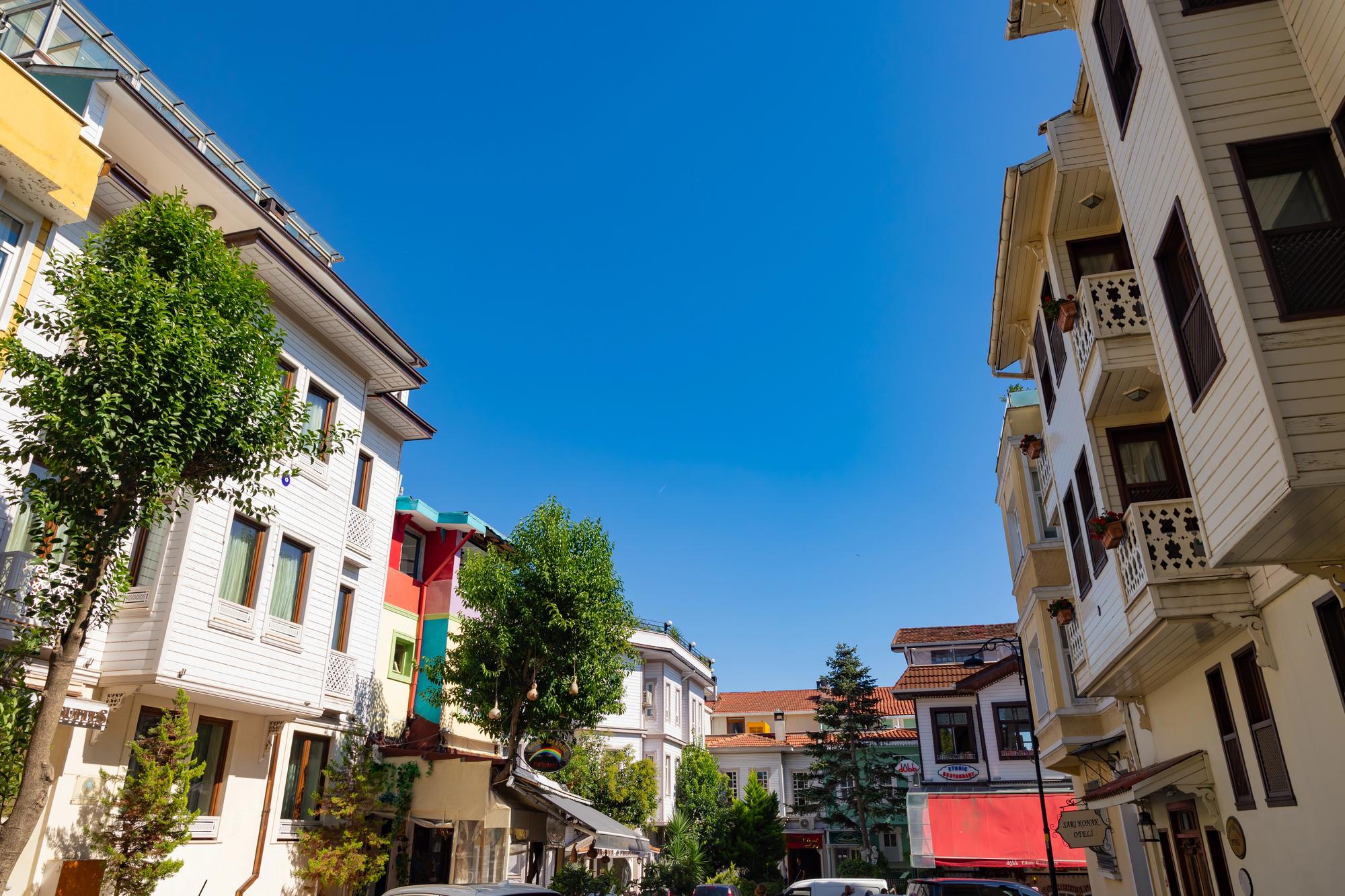
Where to stay in Istanbul: Compare hotels by area
Sultanahmet: For a first visit
This is the historic district and the reason most people come. Hagia Sophia and the Blue Mosque face each other across a square, with the Hippodrome alongside and Topkapı Palace a few minutes away. The Basilica Cistern and the Grand Bazaar are both a short walk. Dig anywhere here, and you hit something. Even the scrappy car parks and patches of grass sit on ancient ruins, which tells you what you need to know about the density of it.
Sleeping in this part of the old city means you walk out of your hotel and you’re at the Blue Mosque. That’s the whole argument for a central location, and it’s a strong one. You can be at the Hagia Sophia ticket gate as it opens, come back for a rest at midday when the heat and the crowds peak, and go out again at six when the day-trippers have gone, and the square is yours. Nobody staying across the water manages that.
Worth knowing before you plan your mornings. Since 2024, tourists visit Hagia Sophia’s upper gallery on a paid ticket, and it closes to visitors for each of the five daily prayers, with a longer closure on Friday around midday. Check the day’s prayer times, book online, and go early.
Accommodation runs the full range. Restored Ottoman mansions and boutique hotels in the quieter backstreets, simple pansiyons with a rooftop terrace looking over the domes and minarets, and a lot of mid-range places trading purely on the postcode. Book away from Divan Yolu if you want to sleep.
There’s a compromise, though. Barely any residential rhythm can be found in Sultanahmet. There isn’t a lived-in feel, and the restaurants know their customers are here once and then gone. You’ll eat better almost anywhere else on this list.
Best for: The first-time visitor, short trips, families with young children who need to get back to the room fast. No area puts you closer to the major tourist attractions.
Skip if: Food matters more to you than footsteps, or you want to see how the city actually lives.
Getting around: The T1 tram line stops at Sultanahmet and Gülhane. Sirkeci is a few minutes away for the Marmaray under the Bosphorus Strait.
Beyoğlu: For food and evenings
This is where we stayed. Across the Golden Horn from the old city, streets climbing past Galata Tower up to İstiklal Street, the pedestrian avenue with the red tram grinding through the middle of it.
What I liked was that the interesting bits aren’t on İstiklal Street itself. They’re in the narrow streets running off it – small bakeries, courtyards, bars that hold about 12 people. You come out of dinner at 11, and the street is still going. That doesn’t happen in Sultanahmet.
It’s the cultural heart too, and the art galleries are the reason. The Pera Museum, SALT Beyoğlu and SALT Galata in the old Ottoman Bank headquarters, plus a scatter of small independent spaces, with Istanbul Modern down at the water in Karaköy. The area was historically home to the city’s Christian and foreign communities, and the late-19th-century European apartment blocks are still standing, some restored into hotels with high ceilings and proportions you don’t get in a new build.
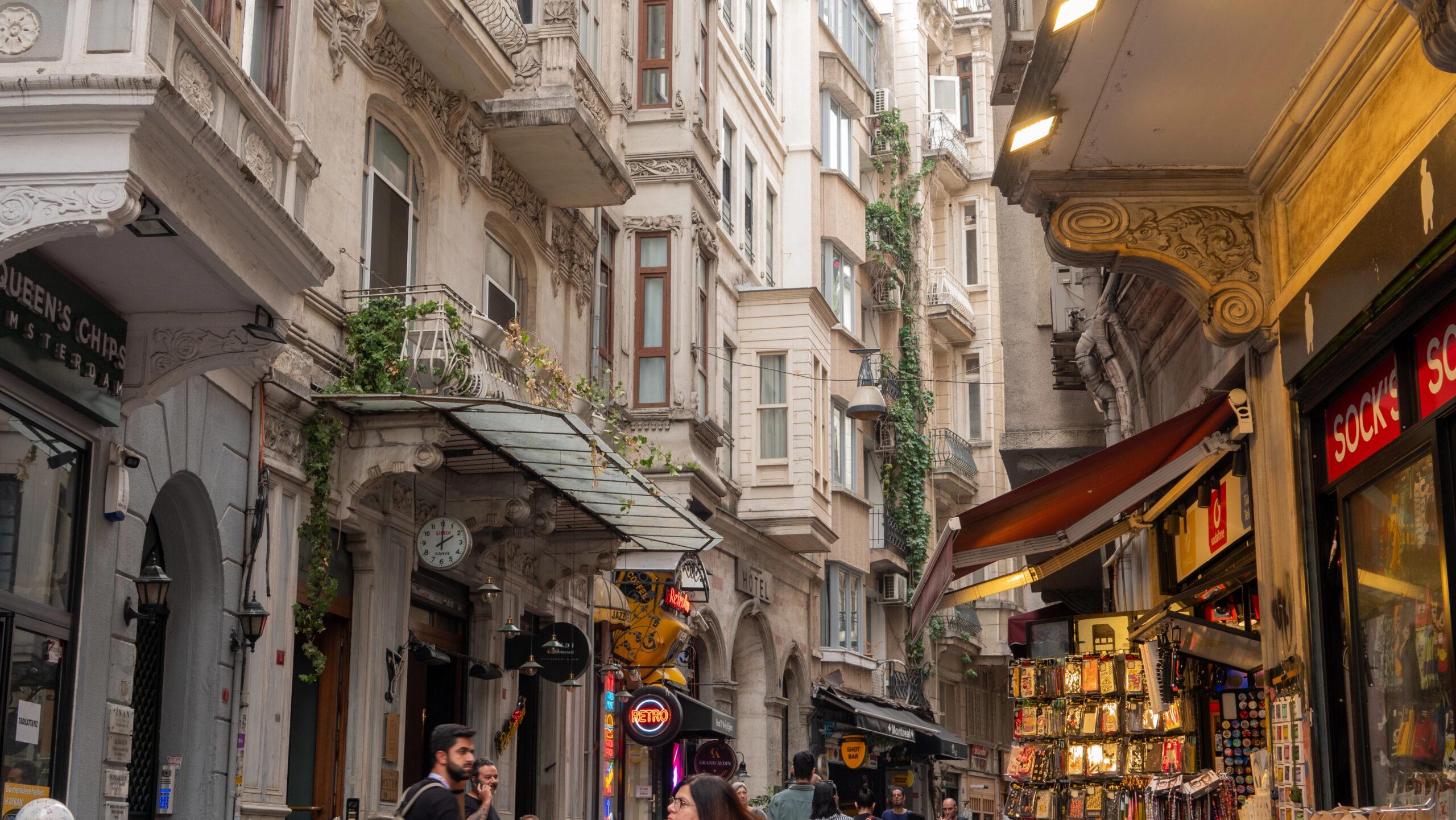
The accommodation is the widest spread in the city. Large chain hotels around Taksim Square, boutique hotels and rental apartments in the quarters below it, hostels for backpackers, and rooftop bars on top of a good number of them.
The compromise: You’re a tram ride from the main tourist attractions rather than a walk. On my trip, that was fine, more of a decision than an inconvenience. It’s also hilly. The walk from the water up to Taksim Square is a steady climb, and you’ll feel it with a suitcase.
Best for: Eating, drinking, art galleries, anyone on a second visit.
Skip if: You want silence at night, or you’re travelling with someone who can’t manage hills.
Getting around: The M2 metro line has stations at Şişhane and Taksim. The F1 funicular drops from Taksim Square to Kabataş, where you pick up the T1 tram.
Karaköy: For boutique hotels and coffee
Karaköy sits at the bottom of the hill where the Galata Bridge lands. A decade ago this was ships’ chandlers, hardware shops and import-export offices. The cafes, galleries and boutique hotels have pushed most of that out, though you can still find a man selling ball bearings next to a flat white costing the same as lunch.
Galataport opened along the waterfront here, a promenade with the world’s first underground cruise terminal, plus Istanbul Modern and several restaurants. There’s an argument that it has smoothed the character out of the shoreline, and that the walk along it, with the old city skyline across the water, is one of the best in Istanbul. Both are true. Go at dusk and decide for yourself.
The compensation is that the backstreets behind it aren’t so polished – but in a good way. You’ll find the intricate Camondo Stairs, artisan coffee shops, Karaköy Güllüoğlu for baklava and Turkish delights, and the ferry terminal right there for crossings to the Asian side. Kılıç Ali Paşa Hamamı, one of the city’s best-regarded spots for a Turkish bath, is one tram stop along at Tophane, in a Mimar Sinan building finished around 1580.
The compromise: It’s a major transport hub, so traffic noise is part of the deal. Budget rooms are thin on the ground. This is mostly mid-range and up, and the boutique hotels here know what they’re worth.
Best for: Design-led stays, coffee, ferries, walking to both sides of the Golden Horn.
Skip if: You’re counting pennies or you’re a light sleeper.
Getting around: T1 tram at Karaköy. Ferries to Kadıköy and Üsküdar. The F2 Tünel, a short underground funicular, climbs to Beyoğlu.
Galata: For cobblestone streets and views
Uphill from Karaköy, wrapped around the tower. This is one of the oldest corners of the city, and the Galata Tower has stood roughly midway up the slope since the 14th century. You see it from most streets and a good number of windows. The area has been thoroughly smartened up, but the history hasn’t been scrubbed off with it.
Serdar-ı Ekrem is the street to know, running off the square at the tower’s base, lined with cafes and the boutiques of fashion designers. Galip Dede is the other one, full of art galleries, music shops and small hotels. It’s the most photogenic place to stay in Istanbul.
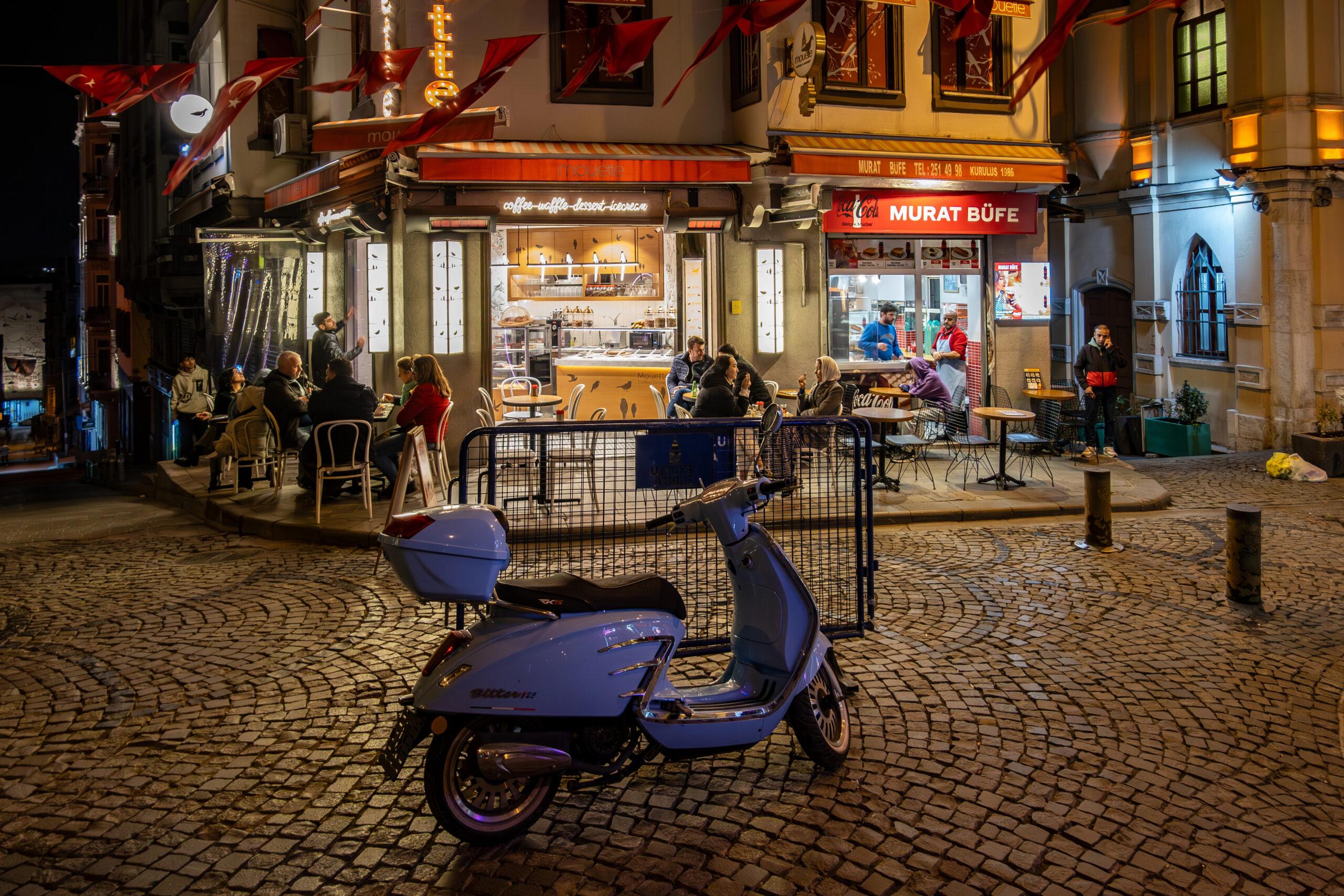
The historic buildings are the draw for accommodation. Converted apartment blocks and former bank premises on Bankalar Caddesi, high ceilings, and a fair number of rooms angled at a tower view. Check what you’re paying for that view before you book.
The compromise: Everything is uphill, on cobblestone streets, and the lanes around the base are busy with tower queues. You’re paying for the postcard.
Best for: Couples, photographers, anyone who wants the tower out of the window.
Skip if: Wheels, knees or prams are a factor.
Getting around: Walk down to Karaköy for the T1, or Şişhane for the M2 metro line.
Cihangir: For a quiet residential area
Downhill from Taksim towards the water, Cihangir is where you stay when you want Beyoğlu’s local restaurants without Beyoğlu’s noise. It’s one of a handful of quarters inside Beyoğlu, along with Çukurcuma, Galata and Karaköy, where the accommodation is smaller hotels and rental apartments rather than anything with a lobby.
It’s leafy, low-key, full of cats and coffee shops where people are working rather than sightseeing. Twenty minutes’ walk gets you to İstiklal Street, and the popular attractions are all a tram ride from the bottom of the hill. It’s the closest thing to living somewhere rather than visiting, and the apartment rentals tend to come with kitchens, air conditioning and enough space to unpack.
The compromise: Nothing to see here, in the literal sense. No sights, and you’ll walk or tram to all of them.
Best for: Longer stays, repeat visitors, anyone renting an apartment.
Skip if: You have two days and a list.
Getting around: Walk to Taksim for the M2, or down to Kabataş for the T1 tram.
Beşiktaş: For Bosphorus Strait views
North along the water from Kabataş. Beşiktaş and neighbouring Ortaköy hold most of the city’s serious luxury hotels, the international names, and they’re all pointed at the water. If waking up to the Bosphorus is the point of the trip, this is the address. The best hotels here are built around the sea views rather than the central location, and they charge accordingly.
Beşiktaş itself isn’t just hotels though. It’s a young, busy interchange with a market at the centre of it and unfussy bars and cheap places to eat crowded around. In Akaretler, near the Naval Museum, a terrace of 19th-century Ottoman townhouses has been restored into cafes and exhibition spaces. Between Beşiktaş and Ortaköy sits Yıldız Park, once the sultan’s hunting ground, now the place for a long Turkish breakfast in a century-old pavilion.
Ortaköy has the baroque mosque on the water under the first Bosphorus Bridge. Both have ferry terminals, though Beşiktaş has more connections. Dolmabahçe Palace sits between here and Kabataş, the 19th-century answer to the great European courts, and it’s a short walk from most of the waterfront hotels. Note it shuts on Mondays.
I had a work thing at the Ritz-Carlton nearby, which meant a couple of drinks in the bar and sundowners up on the roof. It’s a beautiful hotel, and the rooftop looks straight out over the Bosphorus, though it’s firmly on the swanky side and priced to match. Even if you’re not staying, the roof is open seasonally for a drink with that view.
The compromise: You’re a fair way from the old city, and Istanbul traffic makes distance expensive in time.
Best for: Sea views, luxury, couples, ferry-hopping up the Bosphorus Strait.
Skip if: Sightseeing efficiency is the priority.
Getting around: Ferry terminal at Beşiktaş. Buses down to Kabataş for the T1 tram line.

Kadıköy: For local life and street food
Over on the Asian side of Istanbul, 20 minutes on the ferry. I went across for the day and wished I’d had longer.
Kadıköy has gone from sleepy to unmissable in about a decade. It runs day and night now, full of third-wave coffee shops, boutiques, small galleries, cocktail bars and live music. Here’s the thing that matters though. There are barely any sights. The attraction is the place itself, and the sunsets from the waterfront promenade.
Kadife Sokak, universally called Barlar Sokak or Bar Street, is quiet by day and full after dark. The produce market is one of the best in the city and the street food is the reason to come. Kumpir, lahmacun, midye dolma from a cart, börek from a hole in the wall. Moda stretches along the Marmara, and the tea gardens on the promontory there cost almost nothing and look straight out over the water.
The compromise: Hotels are limited here and mostly cluster near the water, so book early. You’re also committing to a ferry every time you want a monument, and they thin out late in the evening.
Best for: Second or third visits, food, anyone who’d rather see how Istanbul lives.
Skip if: It’s your first trip and Hagia Sophia is the reason you came.
Getting around: Ferries to Eminönü, Karaköy and Beşiktaş. The Marmaray runs under the water to Sirkeci. The T3 tram loops round to Moda.
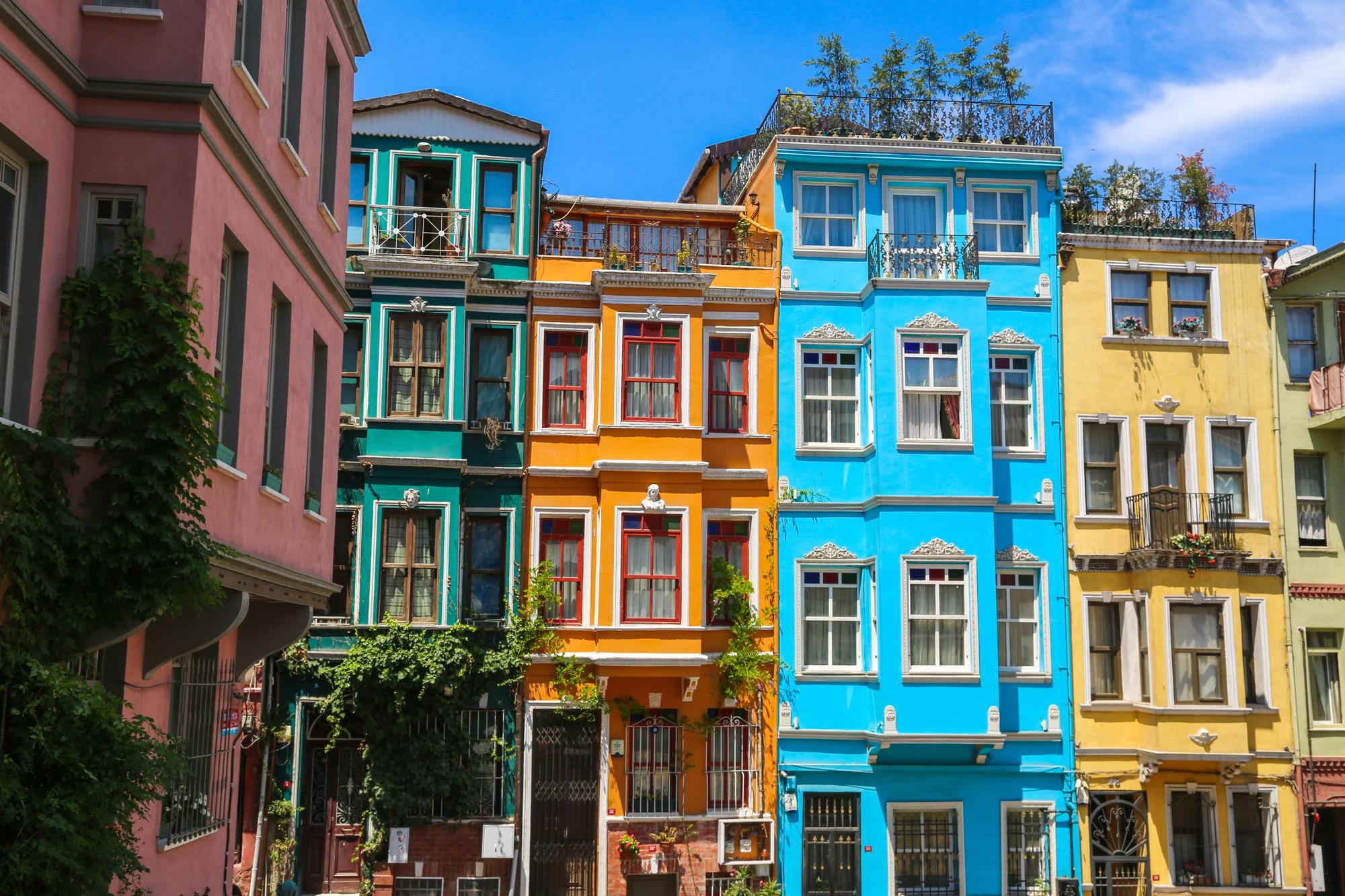
Balat and Fener: For photogenic and cheap
Along the Golden Horn, west of the old city, still inside the Fatih district. Rows of painted old homes on cobbled streets, the landmark “iron church” and the Patriarchal Church of St George, and more film crews and influencers than you’d think a residential street could hold. The antique shops pull in collectors and bargain hunters, especially on auction days, and the cafes are thriving on the back of all of it.
This is the most Instagrammed corner of Istanbul, and knowing that in advance helps. The streets are lovely. So is everyone’s photograph of them.
The compromise: There aren’t many hotels, and there’s next to no nightlife. Getting back to Sultanahmet or Beyoğlu at the end of a day is easy enough on the waterside tram, or the Golden Horn ferry if you’d rather take the slow, scenic version. But you’re planning journeys rather than strolling.
Best for: Budget stays, apartments, photographers, longer trips.
Skip if: You want to walk home from dinner.
Getting around: The T5 tram line runs along the Golden Horn from Eminönü and stops at Balat and Golden Horn ferry. Stay on the tram up to Eyüpsultan, and you reach the Eyüp cable car, a three-minute lift up to Pierre Loti hill for the long view back down the water. It takes your Istanbulkart like everything else.
What to look for in an Istanbul hotel
A few things worth checking before you book, wherever you land.
- Air conditioning. Non-negotiable between June and September. Older converted buildings don’t always have it in every room.
- Which way the hill runs. Plenty of Galata and Beyoğlu hotels sit a five-minute walk from the metro that’s five minutes down and fifteen back up.
- A rooftop terrace. Common in Sultanahmet and worth having. It’s where breakfast happens and where the domes look best at dusk.
- Distance to metro stations or a tram stop. More useful than distance to a sight. Traffic makes anything else unreliable.
- Room size. Historic buildings mean high ceilings and small footprints. Modern amenities and comfortable rooms often mean a newer block further out.
- Lifts. A converted Ottoman townhouse may be four floors of stairs.
- Book early for spring and autumn. April to May and September to October are peak. Favourite hotels in Sultanahmet and Galata go months ahead.
One base or two?
For three or four days, pick one and stay put. Istanbul is a huge city, and moving hotels mid-trip costs you half a day you can’t spare.
For a week or more, splitting works well. A few nights in the Sultanahmet district for the monuments, then across the water to Beyoğlu or Kadıköy for the second half. You get two cities for one flight, and the contrast is the point.
Getting around Istanbul from wherever you stay
The T1 tram line does most of the work for visitors. It runs from Kabataş on the Bosphorus through Karaköy, over the Galata Bridge to Eminönü, then Sirkeci, Gülhane and Sultanahmet, on to Beyazıt-Kapalıçarşı for the Grand Bazaar. That’s most of this guide on one line. It’s 19.3km, 31 stations, running 06:00 to midnight, with trams every two minutes at peak.
The useful connections, per Metro İstanbul. At Kabataş, the F1 funicular up to Taksim Square. At Karaköy, the F2 Tünel up to Beyoğlu plus ferries. At Eminönü, the T5 tram along the Golden Horn plus ferries. At Sirkeci, the Marmaray under the Bosphorus to the Asian side.
Get an Istanbulkart when you land. It covers every form of public transportation here, from the tram and metro line to buses, ferries and funiculars, and it’s cheaper than tapping a bank card. Tap in and tap out. People forget the second one and get charged oddly on the next trip. Fares change often enough that it’s worth checking the current tariff rather than trusting a blog, including this one.
On taxis, my experience matched the warnings. The traffic here is a different order of magnitude, and there were stretches where walking a kilometre beat sitting in a cab doing the same. If you take one, check the meter is running.
Frequently asked questions
What is the best area to stay in Istanbul for first-time visitors?
The Sultanahmet district. Hagia Sophia, the Blue Mosque, Topkapı Palace and the Basilica Cistern sit within walking distance of each other, so you lose no time in transit. Check the closing days before you plan, as Topkapı shuts on Tuesdays. The trade-off is that it’s touristy and the restaurants are weaker than elsewhere. Beyoğlu is the alternative if you’d rather eat well and take the tram to the major attractions.
Is it better to stay on the European or Asian side of Istanbul?
The European side of Istanbul for a first visit, since almost all the main tourist attractions are there. The Asian side of Istanbul, and Kadıköy in particular, suits repeat visitors who want local life, street food and lower prices. Ferries run about twenty minutes between the two, but they thin out late in the evening.
Which area of Istanbul has the best food?
Beyoğlu and Kadıköy. Beyoğlu has the meyhanes, the ocakbaşı grills and the contemporary restaurants. Kadıköy has the produce market and the local restaurants people actually eat in. Sultanahmet is the weakest for food of any area here.
Is Sultanahmet too touristy to stay in?
It depends what you want. It’s undeniably tourist-focused, with little residential life left. But you can be at Hagia Sophia for opening before the queues build, and back in the square at dusk once the coaches have gone, which nobody staying across the water manages.
Where should I stay in Istanbul on a budget?
Balat and Fener for apartments and low prices, though hotels are limited and you’ll rely on the T5 tram line. Beyoğlu has budget rooms and hostels alongside everything else, and better metro stations. Sultanahmet has cheap pansiyons, some with a rooftop terrace looking over the domes.
Which area has the best hotels for Bosphorus views?
Beşiktaş and Ortaköy, where the luxury hotels are designed around the sea views rather than the central location. Ortaköy sits under the first Bosphorus Bridge with its baroque mosque on the water. Both have ferry terminals, Beşiktaş with more connections.
Is Taksim Square a good place to stay?
It’s one of the best-connected spots in the city, with the M2 metro line, the airport buses and the F1 funicular down to the tram. That’s the argument for it. Against it, the square is a transport interchange rather than a destination, and the streets immediately around it are the least interesting part of Beyoğlu. Stay below it, towards Galata or Cihangir, and you get the connections without the concrete.
Where is best to stay with young children?
Sultanahmet, for the short walk back to the room when someone melts down mid-afternoon. Beşiktaş works too if you want a pool and space. Avoid Galata and Cihangir with a pram, as the cobblestone streets and hills are hard work.
How many nights do you need in Istanbul?
Three covers the main attractions without rushing. Four or five lets you add the Asian side, Balat, or a Turkish bath and a slower pace. For three or four nights, stay in one place rather than moving.
Do I need to stay near a tram or metro station?
Yes. Istanbul traffic is severe enough that buses and taxis are unreliable at peak times. Every area in this guide has a tram line, metro line or ferry terminal within walking distance, and that’s what makes them work as a base.